English
 Español

 Inquiry
Industry News
Home / News / Industry News / Which Fiber Optic Patch Cord Types Should You Choose for High-Speed Connectivity?
2026-05-02
Selecting the correct fiber optic patch cord types is determined by your specific application's distance, bandwidth, and hardware compatibility requirements. Generally, fiber optic patch cords are categorized into two main groups based on the transmission mode: single-mode fiber (SMF) for long-distance communication and multi-mode fiber (MMF) for short-reach local area networks. By matching the correct connector (such as LC, SC, or MTP) and polish type (UPC or APC) to your equipment, you can ensure minimal signal loss and maximum data integrity across your infrastructure.
Content
The primary classification of fiber optic patch cord types begins with the optical mode, which dictates how light travels through the fiber core. This distinction is critical because mixing different modes can lead to total signal failure or significant data packet loss.
Single-mode fiber patch cords are designed for long-range data transmission, often reaching distances of up to 40 kilometers or more without the need for signal regeneration. They feature a very small glass core, typically $9\mu m$ in diameter, which allows only one mode of light to propagate. This eliminates modal dispersion, which is the spreading of light pulses over time.
The refractive index $n$ of the core is slightly higher than the cladding to ensure total internal reflection. In technical terms, the core-to-cladding ratio is expressed as 9/125. Because the light travels in a single path, single-mode fiber offers the highest bandwidth potential. It is most commonly used in telecommunications, CATV networks, and large-scale data center interconnects where high-speed links like 100G or 400G Ethernet are required over kilometers.
Multi-mode fiber patch cords are the standard choice for short-distance applications within buildings or data center racks. These cables have a much larger core diameter, either $50\mu m$ or $62.5\mu m$, which allows multiple "modes" of light to travel simultaneously.
The physical interface of fiber optic patch cord types is defined by the connector, which must match the optical transceiver or patch panel port. Connectors are engineered to align the microscopic fiber cores perfectly to ensure the light signal passes through with minimal attenuation.
The LC connector is currently the most popular choice for high-density environments due to its small form factor. It uses a 1.25mm ferrule, which is half the size of traditional connectors, allowing double the port density on patch panels and switches. Its "push-and-latch" mechanism makes it easy to install and secure, which is why it is the standard interface for SFP and SFP+ transceivers.
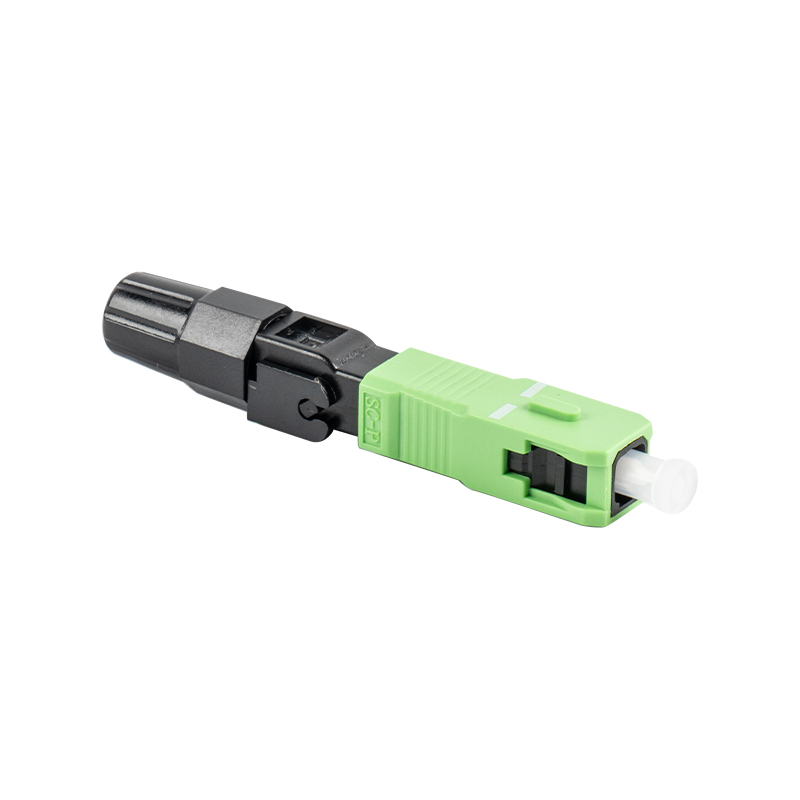
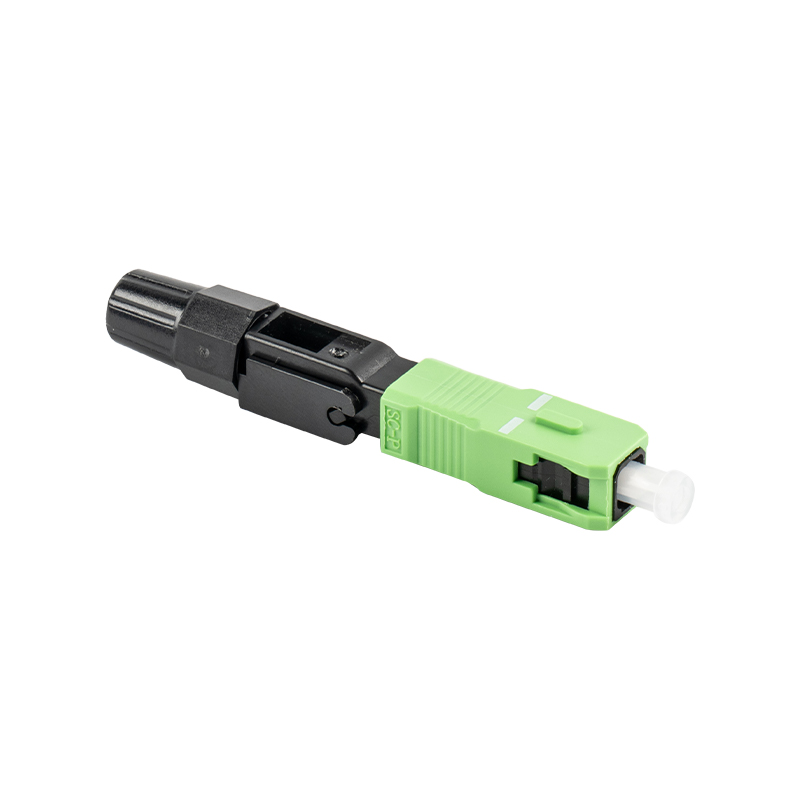
SC connectors are widely utilized in telecommunications and GPON (Gigabit Passive Optical Network) installations. Featuring a 2.5mm ferrule and a "push-pull" locking mechanism, the SC connector provides excellent durability and a very stable connection. While larger than the LC, it remains a favorite for wall-mount enclosures and older network equipment.
The MTP/MPO connector is the go-to solution for high-speed 40G and 100G backbone cabling. Unlike single-fiber connectors, MTP/MPO can house 8, 12, 24, or even 72 fibers within a single rectangular ferrule. This drastically reduces installation time and simplifies cable management in massive data centers where thousands of fibers are required.
The end-face polish of a fiber connector significantly impacts the return loss, which is the amount of light reflected back toward the source. Lower reflection is essential for maintaining the stability of laser sources and preventing data errors in high-frequency systems.
| Polish Type | Acronym | Color Code | Typical Return Loss |
| Ultra Physical Contact | UPC | Blue | $\le -50dB$ |
| Angled Physical Contact | APC | Green | $\le -60dB$ |
Comparison of UPC and APC polish types for fiber optic patch cords.
APC (Angled Physical Contact) connectors feature an 8-degree angle on the ferrule end-face. This angle causes reflected light to leak out into the cladding rather than traveling back down the fiber core. APC is mandatory for sensitive applications like FTTx and video signals over fiber. In contrast, UPC (Ultra Physical Contact) is sufficient for most standard digital data applications. Crucially, APC and UPC connectors cannot be mated together, as the physical gap caused by the angle would result in extremely high insertion loss.
The outer material of a fiber optic patch cord is designed to protect the glass from physical stress and meet local building safety codes regarding fire and smoke. Choosing the wrong jacket type can result in non-compliance with fire regulations or increased risk during an emergency.
OFNR cables are intended for vertical shafts that connect one floor to another. They are engineered to prevent a fire from traveling between floors. They are generally more robust than standard patch cords but are not suitable for air plenum spaces.
OFNP cables are the most fire-resistant and are required for use in plenum spaces (areas used for air circulation, such as drop ceilings or raised floors). These cables are made with materials that emit very little smoke and zero toxic fumes when burned, ensuring safety for occupants in a building.
LSZH patch cords are widely used in Europe and in confined spaces like ships or aircraft. If they catch fire, they do not produce the thick black smoke or the corrosive acid (halogen) produced by standard PVC jackets. This makes them ideal for environments where human safety and the protection of sensitive electronic equipment are paramount.
Understanding the data throughput and distance limits of different fiber optic patch cord types is vital for network planning and scalability.
| Fiber Type | 1Gbps Distance | 10Gbps Distance | 40/100Gbps Distance |
| OM1 (62.5/125) | 275m | 33m | Not Recommended |
| OM3 (50/125) | 1000m | 300m | 100m |
| OM4 (50/125) | 1100m | 400m | 150m |
| OS2 (9/125) | Up to 10km+ | Up to 40km | Up to 40km+ |
Table showing distance capabilities across different fiber optic patch cord types and speeds.
Maintaining cleanliness is the single most important factor in ensuring that fiber optic patch cord types perform to their rated specifications. Even a microscopic dust particle can block the light path or scratch the delicate glass ferrule upon connection.
Before any installation, technicians should follow the "Inspect, Clean, Inspect" (ICI) workflow. An inspection microscope is used to verify the end-face condition. If contamination is found, specialized cleaning tools like "one-click" cleaners or lint-free wipes with $99\%$ pure isopropyl alcohol should be used. Remember: never touch the fiber end-face with your bare hands, as skin oils are extremely difficult to remove and will cause signal degradation.
The choice between simplex and duplex fiber optic patch cords depends on whether your data needs to travel in one direction or both simultaneously.
No, you cannot mix fiber modes because the core diameters are incompatible; doing so will result in high signal loss and the link will not establish.
Armored fiber optic patch cord types include a flexible steel tape inside the jacket to protect the glass core from rodents, heavy crushing, or accidental kinking in harsh environments.
Yes, industry standards use color coding (Yellow for Single-mode, Aqua for OM3/OM4, Lime Green for OM5) to help technicians quickly identify the cable type and avoid installation errors.
In summary, finding the right fiber optic patch cord types involves a systematic evaluation of your network's distance, speed, and safety requirements. By prioritizing laser-optimized multi-mode fibers for local data center links and single-mode fibers for your long-haul backbones, you can build a resilient and high-performing optical infrastructure. Always ensure that connectors are clean and that you match the correct polish types (UPC/APC) to prevent costly downtime and signal instability.

No.255 Lianfei Road, KandunIndustrial Park, Cixi City, ZhejiangProvince, China
Email: [email protected]
Tel: +86 18367407397
Copyright ? Ningbo Goshining Communication Technology Co., Ltd. Fiber Optic Solutions Manufacturer Fiber Optic Products Factory