English
 Español

 Inquiry
A fiber optic cable clamp is a mechanical fastener that secures fiber cable to a pole, wall, tray, or building facade while limiting movement, strain, and bend-radius damage. It is not just a low-cost accessory on the bill of materials. In practice, the clamp often decides whether a drop cable survives wind, ice, vibration, and routine maintenance without developing a tight bend or a crushed jacket.
The practical answer is to match the clamp to the cable type, outer diameter, route, and load. Indoor drop cable, aerial ADSS, figure-8 cable, and patch cord inside a cabinet all need different grip geometry and materials. A clamp that is too loose lets the cable slide and abrade; one that is too tight can deform the jacket and press on the fiber. The selection points below focus on those failure modes.
Content
What a Fiber Optic Cable Clamp Does
The clamp's job is to control cable movement without becoming a load point on the fiber. That means it must hold the cable against the intended force, spread pressure over a safe area, and keep the cable above its minimum bend radius. A clamp is not a universal substitute for a tension fitting, a suspension unit, or a cable tie.
- Strain relief: keeps pull and vibration away from connectors, splices, and terminal boxes.
- Route control: holds cable along walls, poles, trays, and facades at a fixed spacing.
- Bend-radius protection: supports the cable without sharp edges, point loads, or side pressure.
- Environmental resistance: resists UV, moisture, salt, and temperature cycling where the route demands it.
- Serviceability: allows re-entry, re-routing, or replacement without damaging the jacket.
Not every clamp carries the same duty. A plastic drop clamp anchors a light indoor cable, a J-hook suspension clamp supports an aerial span, and a wedge clamp takes longitudinal tension at a dead-end. Mixing these duties is a common cause of jacket damage and callbacks.
Common Clamp Types and Route Fit
The clamp type should follow the route and cable construction, not the other way around. Start with the cable OD, the expected load, and the mounting surface, then choose the hardware family that matches those facts.
| Clamp type | Typical route | What it controls | Watch point |
|---|---|---|---|
| Plastic drop clamp | Indoor wall runs, FTTH drop cable, customer premises | Light anchoring and routing | UV stability and mounting substrate |
| Stainless steel clamp with band | Pole or facade mounting, outdoor cable | Fixed attachment and abrasion resistance | Band tension and steel grade |
| J-hook suspension clamp | Aerial figure-8 and ADSS routes | Vertical load, sag, and span support | Insert material and hook size |
| Wedge or dead-end clamp | Tension termination at poles and anchors | Longitudinal pull | Cable OD range and wedge seating |
Plastic cable clamps are the usual choice for indoor wall runs, small drop cables, and customer-premises work where the load is light. They should be UV-stabilized if they will see sunlight, and the screw or adhesive base must suit the wall material.
 Cable Clamp PlasticCable Clamp Plastic is made of high-quality plastic material, with excellent durability and durability, able to withstand the wear and tear of daily use. Its smooth su...View Product →
For overhead figure-8 and ADSS routes, J-hook suspension clamps support the cable while keeping the fiber bundle away from sharp edges. The hook must match the cable or messenger diameter, and the insert must not harden or slip under wind movement.
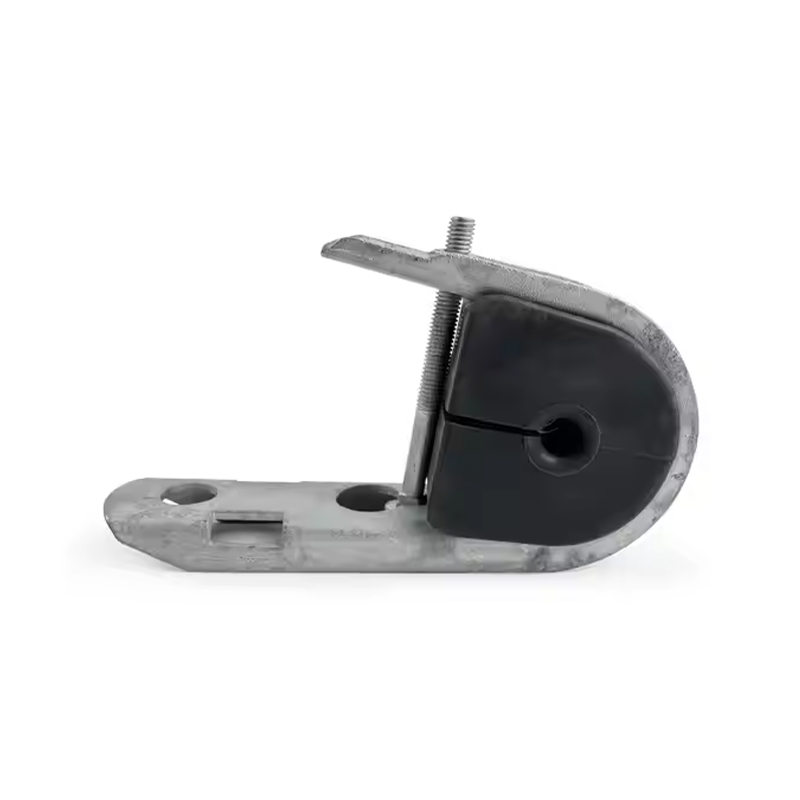 J Hook Suspension Clamp for Fiber Optic CableJ-hook fiber clamp with two adjustment holes for flexible hanging position in overhead figure-8 or ADSS suspension routes.View Product →
Materials, Finishes, and Environmental Limits
Material choice is driven by corrosivity, UV exposure, and load, not by appearance. A coastal site, a chemical plant, and an indoor riser can use the same cable but need very different clamp materials.
| Material or finish | Corrosion and UV behavior | Typical use | Procurement check |
|---|---|---|---|
| UV-stabilized plastic | Good for indoor and sheltered outdoor use when properly stabilized | Drop cable, wall routing, light duty | UV additive and operating temperature range |
| 304 stainless steel | Good general corrosion resistance | Pole, facade, and outdoor hardware | Grade certificate and band tensile data |
| 316 stainless steel | Better resistance to salt and chemicals | Coastal, industrial, and humid sites | Material traceability and fastener match |
| Galvanized steel | Cost-effective but coating-dependent | General outdoor support hardware | Coating thickness and cut-edge protection |
Stainless steel clamps and bands are a sound choice for pole and facade mounting, but the grade matters. In coastal or chemical environments, 316 stainless steel is usually safer than 304, and mixed fasteners should be avoided to reduce galvanic corrosion.
 Stainless Steel Cable Clamp for Fiber ManagementStainless steel cable fixing clamp with corrosion and abrasion resistance; confirm material grade and certificates for harsh outdoor sites.View Product →
For any outdoor project, ask for material certificates rather than relying on a “stainless steel” label. A clamp can look correct and still fail early if the band, screw, and insert are not matched to the same exposure class.
How to Size and Specify a Clamp
Size the clamp to the actual cable outer diameter and the worst-case load, then confirm the mounting hardware. Nominal cable size is not enough because jacket thickness and construction vary between cable families.
- Measure the cable OD: check the actual jacket diameter, not only the catalog description.
- Confirm the grip range: the clamp must close on the cable without bottoming out or leaving a gap.
- Define the load: include wind, ice, pull tension, and maintenance loads for aerial routes.
- Check the environment: UV, salt, humidity, temperature, and chemical exposure should set the material.
- Match the mounting: confirm screw, band, adhesive, or hook type against the pole or wall substrate.
- Review tolerances: a 0.5 mm mismatch can change holding force or pinch the jacket.
- Request samples: test the clamp on a short cable section before releasing a project order.
For aerial spans, use the route's design tension and local utility practice. Do not infer load capacity from hook size alone. For indoor vertical runs, a common starting point is one clamp every 1–1.5 m, but the cable maker's recommendation should take priority.
Installation Practices That Protect Optical Performance
Good installation keeps the clamp snug, aligned, and outside the cable's bend limit. The goal is controlled contact, not maximum force.
- Clean the jacket and mounting surface before fitting the clamp.
- Use a rubber or plastic insert where metal contact could create a point load.
- Respect the cable's minimum bend radius; a common field rule is 20× OD during installation and 10× OD in service.
- Tighten bands and screws with the specified tool; stop before the jacket deforms.
- Leave a service loop at enclosures and terminals so future work does not pull the cable.
- Check spacing on vertical runs and at transitions between tray, wall, and pole.
- Inspect after installation for slippage, abrasion, and sharp contact points.
ADSS cable needs particular care because the clamp load is limited by the cable design. Use suspension clamps with the recommended insert or armor rods, and avoid wedge clamps unless the cable maker approves them for that route.
Common Mistakes and Procurement Risks
Most clamp failures come from mismatch, over-tightening, and unverified material claims. These problems often appear months after installation, when the jacket is already deformed or the hardware has started to corrode.
- Using a metal clamp directly on a soft jacket without an insert.
- Choosing a clamp by nominal cable size instead of measured OD.
- Over-tightening a band or screw until the cable ovalizes.
- Installing indoor plastic clamps in direct sun without UV stabilization.
- Using cable ties as a substitute for clamps on long vertical runs.
- Accepting “stainless steel” without a grade certificate.
- Skipping load and corrosion tests because the clamp is a small line item.
A practical procurement check is to ask three questions: What is the cable OD range? What is the proof load or recommended tension? What material certificate supports the corrosion claim? If the supplier cannot answer all three, the risk stays with the buyer.
FAQ
What is the difference between a fiber optic cable clamp and a cable tie?
A clamp provides controlled grip and a fixed mounting point, while a cable tie is mainly for bundling. A tie can over-cinch a fiber cable because it has no built-in stop or load spread.
Can plastic clamps be used outdoors?
Only if they are UV-stabilized and rated for the exposure. Otherwise, use a stainless steel clamp or a protected indoor route.
How tight should a fiber optic cable clamp be?
Snug enough to prevent sliding, but not tight enough to deform the jacket. Use the specified torque or band tension tool and inspect for ovalization.
Which clamp should be used for ADSS cable?
A suspension clamp with a compatible insert or armor rods is the usual choice. The cable maker's span and clamp-load limits should control the final selection.
Can a clamp cause signal loss?
The clamp itself does not normally cause loss, but a tight bend, crush, or point load can. That is why bend radius and jacket condition matter as much as holding force.
A fiber optic cable clamp is a small component with a large effect on long-term network reliability. The right choice is the one that matches cable OD, route load, material exposure, and installation method, then survives the first maintenance cycle without jacket damage.
For project-specific clamp selection, share the cable construction, route, and environmental conditions with our team before the bill of materials is fixed.