

 English
 Español

 Inquiry
Industry News
What is the difference between OM3 and OM4 patch cords?
2026-03-13
The key difference between OM3 and OM4 patch cords lies in bandwidth and transmission distance: OM4 offers an Effective Modal Bandwidth (EMB) of 4700 MHz·km — more than double OM3's 2000 MHz·km — and supports 100G Ethernet over 150 meters, compared to just 100 meters for OM3. Both are multimode fiber types sharing the same 50/125 μm core/cladding structure, but OM4 uses a more refined fiber manufacturing process, making it the preferred choice for high-density data centers and bandwidth-intensive network environments.
Content
- 1 OM3 vs OM4 Patch Cord: Key Technical Specifications
- 2 Why Does OM4 Offer Greater Bandwidth and Longer Reach?
- 3 How to Identify OM3 vs OM4 Patch Cords Visually
- 4 Can OM3 and OM4 Patch Cords Be Mixed?
- 5 Maximum Transmission Distance by Network Speed
- 6 When to Choose OM3 and When to Choose OM4
- 7 Connector Types and Their Impact on OM3/OM4 Performance
- 8 Backward Compatibility and Long-Term Investment Value
- 9 Summary: OM3 or OM4 — Which Should You Choose?
OM3 vs OM4 Patch Cord: Key Technical Specifications
Understanding the technical differences between OM3 and OM4 is the foundation for making the right cabling decision. The table below summarizes the most important parameters side by side.
| Parameter | OM3 | OM4 |
|---|---|---|
| Core/Cladding Diameter | 50/125 μm | 50/125 μm |
| Effective Modal Bandwidth (EMB) | 2000 MHz·km | 4700 MHz·km |
| Overfilled Launch Bandwidth (OFL, 850nm) | 1500 MHz·km | 3500 MHz·km |
| 10G Ethernet Max Distance | 300 m | 400 m |
| 40G Ethernet Max Distance | 100 m | 150 m |
| 100G Ethernet Max Distance | 100 m | 150 m |
| Standard Jacket Color | Aqua | Erika Violet (or Aqua) |
| Governing Standard | TIA-568-C.3 / ISO 11801 | TIA-568-C.3 / ISO 11801 |
Why Does OM4 Offer Greater Bandwidth and Longer Reach?
The performance advantage of OM4 stems from a more precise graded-index refractive profile in the fiber core. This tighter manufacturing tolerance reduces differential mode delay (DMD), meaning light pulses spread less as they travel, which directly translates into higher modal bandwidth and lower signal distortion over longer distances.
In practical terms:
- OM3 provides an EMB of 2000 MHz·km, sufficient for 10G and 40G applications at moderate distances;
- OM4 reaches 4700 MHz·km — 2.35× higher — enabling reliable 100G transmission with parallel optics such as QSFP+ and QSFP28 transceivers;
- At 40G and 100G speeds, OM4 delivers an extra 50 meters of reach over OM3, which is significant in large data center floor layouts.
This difference is especially noticeable when paired with VCSEL (Vertical-Cavity Surface-Emitting Laser) light sources, which are highly sensitive to the modal bandwidth of the fiber they drive.
How to Identify OM3 vs OM4 Patch Cords Visually
Correctly identifying OM3 and OM4 patch cords in the field prevents costly mismatches. The two types can be distinguished by jacket color and labeling.
Jacket Color
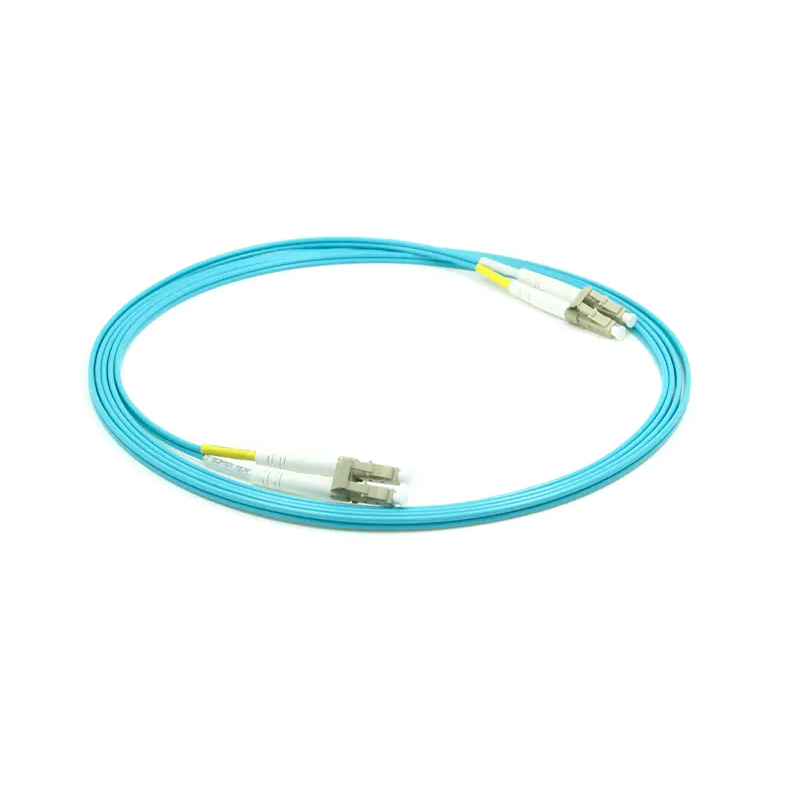
- OM3: Aqua (light blue-green) — the standard color per TIA-568;
- OM4: Erika Violet (light purple) — recommended by IEC 60793-2-10; however, some OM4 cables also use Aqua jackets, so color alone is not always definitive.
Labeling and Print Markings
Reputable patch cords will have "OM3" or "OM4" printed directly on the jacket or connector boot, often accompanied by "50/125" or a bandwidth designation such as "OM4 4700." Always verify the printed marking rather than relying solely on jacket color, particularly when procuring from multiple sources.
Can OM3 and OM4 Patch Cords Be Mixed?
Physically, yes — both types use the same 50/125 μm dimensions, so their connectors are fully compatible and can be mated together. However, mixing them in a single link degrades performance to the lower-rated fiber segment (the weakest-link principle).
For example, in a 40G link:
- An all-OM4 link supports up to 150 meters;
- Mixing OM3 and OM4 segments reduces the effective maximum distance to OM3's 100-meter limit;
- Frequent mixing can also introduce additional insertion loss from mode mismatch at the splice point, increasing bit error rates.
As a best practice, use a consistent fiber grade throughout each individual link. This is especially critical at 100G and above, where any link-budget margin loss becomes much harder to tolerate.
Maximum Transmission Distance by Network Speed
| Network Speed | IEEE Standard | OM3 Max Distance | OM4 Max Distance |
|---|---|---|---|
| 1G | 1000BASE-SX | 550 m | 550 m |
| 10G | 10GBASE-SR | 300 m | 400 m |
| 40G | 40GBASE-SR4 | 100 m | 150 m |
| 100G | 100GBASE-SR4 | 100 m | 150 m |
| 200G | 200GBASE-SR4 | 100 m | 100 m |
When to Choose OM3 and When to Choose OM4
The right choice depends on your current speed requirements, cable run lengths, and upgrade roadmap.
Choose OM3 When:
- Your network operates at 10G with runs under 300 meters;
- You are managing a small-to-medium enterprise network or campus LAN with short inter-rack distances;
- There is no foreseeable need to migrate beyond 40G in the near term;
- You are replacing patch cords in an existing OM3 infrastructure to maintain consistency.
Choose OM4 When:
- You are deploying 40G, 100G, or higher-speed links with runs approaching or exceeding 100 meters;
- You are building or expanding a large data center with high-density spine-leaf architecture;
- Your infrastructure roadmap includes a migration to 400G within the next 5–10 years;
- You are using parallel optics (MPO/MTP interfaces) for structured backbone cabling.
It is worth noting that for 400G and beyond, the industry is increasingly adopting OM5 wideband multimode fiber, which supports Short Wavelength Division Multiplexing (SWDM) to dramatically increase link capacity. However, OM4 remains the practical sweet spot for current 100G deployments.
Connector Types and Their Impact on OM3/OM4 Performance
Regardless of whether you choose OM3 or OM4, the connector type and end-face quality are equally important to overall link performance. Common multimode fiber patch cord connectors include:
- LC Duplex: The most widely used type for SFP/SFP+/QSFP transceivers in 1G through 100G applications; compact form factor;
- SC Duplex: Common in traditional enterprise networks and storage area networks;
- MPO/MTP: Used for 40G/100G/400G parallel transmission, bundling 8, 12, or 24 fibers into a single connector — essential for high-density data center backbone cabling;
- ST: A bayonet-style connector still found in legacy network equipment.
For polishing style, multimode patch cords typically use PC (Physical Contact) or UPC (Ultra Physical Contact) end-face finishes, with typical insertion loss ≤ 0.3 dB. Avoid connecting multimode UPC connectors to APC (Angled Physical Contact) connectors — the 8° angle difference causes significant back-reflection and signal loss, even if they can physically mate.
Backward Compatibility and Long-Term Investment Value
OM4 is fully backward compatible with OM3 equipment. An OM4 patch cord can be plugged directly into any port or transceiver originally designed for OM3 without any physical conflict. This means upgrading to OM4 does not require replacing existing hardware.
From a total cost of ownership perspective, deploying OM4 in new installations offers longer service life:
- When a 10G network is later upgraded to 100G, OM4 cabling can stay in place without re-pulling fiber;
- OM3 runs approaching the 100-meter boundary at 100G leave little headroom for future expansion, potentially forcing a costly re-cabling project;
- For data centers planning continuous capacity growth over a 5–10 year horizon, OM4 is the more economically sound long-term choice.
Summary: OM3 or OM4 — Which Should You Choose?
The decision comes down to three straightforward criteria:
- If your current speed is 10G and cable runs are under 300 meters, OM3 fully meets your needs;
- If you are running 40G or 100G, or distances exceed 100 meters, OM4 is the right choice;
- For new data center builds or any network with a clear upgrade path, deploying OM4 from the start avoids future re-cabling costs.
The fundamental difference between OM3 and OM4 is not in their physical structure — both are 50/125 μm graded-index multimode fiber — but in manufacturing precision and achievable bandwidth. OM4 is a performance upgrade over OM3, not a replacement of a different technology. In the right application, both are reliable, standards-compliant multimode fiber solutions.

get in Touch

No.255 Lianfei Road, KandunIndustrial Park, Cixi City, ZhejiangProvince, China
Product Center
contact details
-
Email: [email protected]
-
Tel: +86 18367407397
Mobile
Copyright ? Ningbo Goshining Communication Technology Co., Ltd. Fiber Optic Solutions Manufacturer Fiber Optic Products Factory
