English
 Español

 Inquiry
When comparing LC vs SC fiber connectors, the short answer is: LC connectors are better for high-density data center and enterprise networking applications, while SC connectors are preferred for telecom infrastructure, long-haul networks, and installations where ease of field termination matters. LC connectors use a 1.25 mm ferrule and snap-lock mechanism; SC connectors use a larger 2.5 mm ferrule with a push-pull locking body. Neither is universally superior — the right choice depends on port density requirements, budget, environment, and the equipment already in place.
Content
- 1 What Are LC and SC Fiber Connectors?
- 2 LC vs SC Fiber: Head-to-Head Specifications
- 3 Optical Performance: Do LC and SC Connectors Differ in Signal Quality?
- 4 LC vs SC Fiber: Which Is Used Where?
- 5 LC vs SC Fiber: Application Deployment Guide
- 6 LC vs SC with Singlemode and Multimode Fiber
- 7 How to Connect LC to SC: Adapters, Hybrids, and Conversion Cables
- 8 LC vs SC Fiber Cost Comparison
- 9 Frequently Asked Questions: LC vs SC Fiber
- 9.1 Q: Can I plug an LC connector into an SC port?
- 9.2 Q: Is LC or SC better for long-distance fiber runs?
- 9.3 Q: Why does my home fiber internet use SC/APC connectors?
- 9.4 Q: What does LC duplex mean?
- 9.5 Q: Which connector is easier to install in the field?
- 9.6 Q: Are SC connectors being phased out?
- 9.7 Q: What other fiber connector types should I know about besides LC and SC?
- 10 Summary: How to Choose Between LC and SC Fiber
What Are LC and SC Fiber Connectors?
Both LC (Lucent Connector) and SC (Subscriber Connector, also called Standard Connector) are standardized fiber optic connector types used to terminate and connect optical fiber cables. They are the two most widely deployed fiber connector formats in the world — together accounting for the vast majority of installed fiber connections in enterprise, data center, and telecommunications environments.
What Is an LC Fiber Connector?
The LC fiber connector was developed in the 1990s as a smaller alternative to the SC connector, designed specifically to address the growing need for higher port density in networking equipment. Its defining characteristics are:
- Ferrule diameter: 1.25 mm — exactly half the size of an SC connector's ferrule
- Body size: Approximately 6.4 mm wide × 30 mm long — roughly the footprint of an RJ45 connector
- Latching mechanism: A small plastic tab (similar to an RJ45 clip) that snaps into place and requires a pinch to release
- Configuration: Available as simplex (single fiber) or duplex (two fibers side-by-side in a single housing)
- Standards compliance: IEC 61754-20, TIA-604-10 (FOCIS-10)
Because the LC connector is half the size of an SC connector, twice as many LC ports can be packed into the same panel space. A standard 1U patch panel holds 48 LC duplex ports versus only 24 SC duplex ports — a density difference that becomes enormously significant in large data centers where rack space costs thousands of dollars per unit per year.
What Is an SC Fiber Connector?
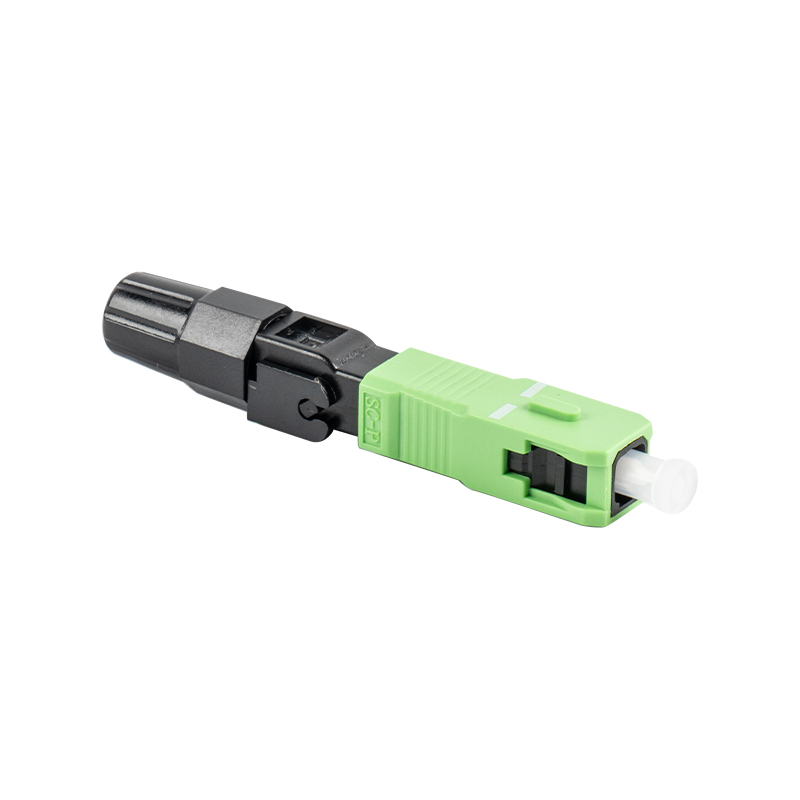
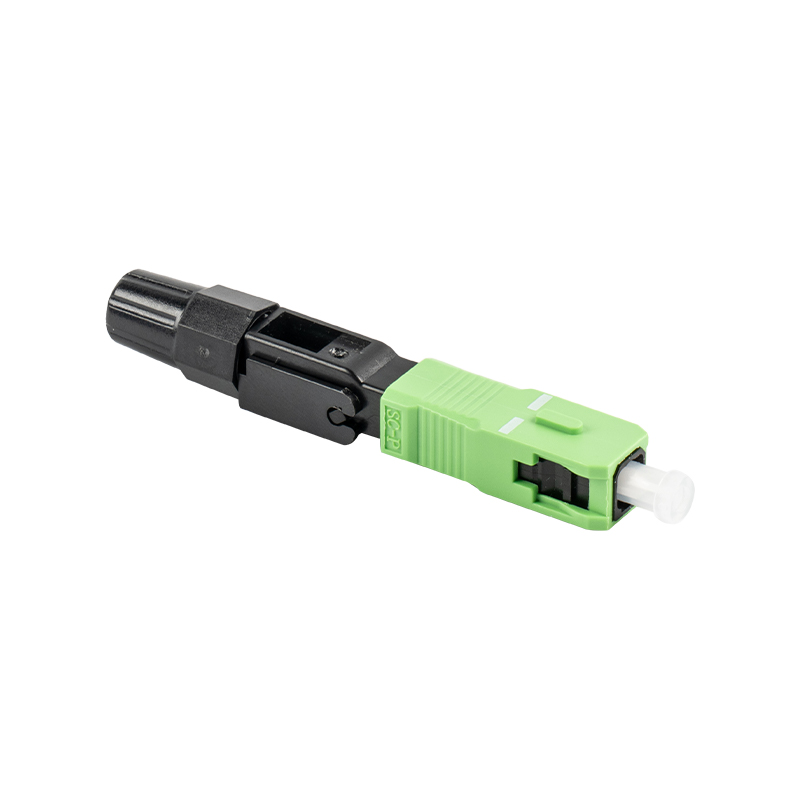
The SC fiber connector was developed by NTT in Japan in the late 1980s and became one of the first fiber connectors to achieve widespread international standardization. It dominated global fiber deployments through the 1990s and into the 2000s. Its key characteristics include:
- Ferrule diameter: 2.5 mm — the largest among common single-fiber connector types
- Body size: Approximately 8.8 mm wide × 45 mm long
- Latching mechanism: A robust push-pull locking body that clicks firmly into place and releases by pulling straight back — no finger dexterity required
- Configuration: Available as simplex or duplex; duplex SC connectors use a plastic clip to hold two simplex connectors side by side
- Standards compliance: IEC 61754-4, TIA-604-3 (FOCIS-3)
The SC connector's larger ferrule size makes it slightly more forgiving of alignment tolerances during field termination and gives technicians a larger, easier-to-handle connector body — a practical advantage in harsh environments, outdoor installations, and situations where technicians may be working with gloves or in confined spaces.
LC vs SC Fiber: Head-to-Head Specifications
| Specification | LC Connector | SC Connector |
| Ferrule diameter | 1.25 mm | 2.5 mm |
| Connector body width | ~6.4 mm | ~8.8 mm |
| Connector body length | ~30 mm | ~45 mm |
| Latch mechanism | Snap-tab (RJ45-style clip) | Push-pull locking body |
| Typical insertion loss | ≤ 0.3 dB | ≤ 0.3 dB |
| Return loss (PC polish) | ≥ 26 dB | ≥ 26 dB |
| Return loss (APC polish) | ≥ 60 dB | ≥ 60 dB |
| Mating cycles (rated) | ≥ 500 | ≥ 1,000 |
| 1U duplex port density | 48 ports | 24 ports |
| Field termination ease | Moderate (small size) | Easy (larger body) |
| Relative connector cost | Slightly higher | Slightly lower |
| Primary standard | IEC 61754-20 / FOCIS-10 | IEC 61754-4 / FOCIS-3 |
Table 1: Side-by-side technical specifications of LC vs SC fiber connectors. Both connector types support equivalent optical performance; differences are primarily physical and mechanical.
Optical Performance: Do LC and SC Connectors Differ in Signal Quality?
In terms of optical performance, LC and SC connectors are essentially equivalent when both are properly manufactured and terminated. The optical signal quality is determined by the polish type and ferrule alignment precision, not the connector body size. Both connector types are available in three main polish grades:
- PC (Physical Contact): The fiber end face is polished to a slight convex curve so the fiber cores make physical contact, eliminating the air gap that causes back-reflections. Return loss ≥ 26 dB. Used for standard multimode and singlemode applications.
- UPC (Ultra Physical Contact): A finer polish producing a more precise contact surface. Return loss ≥ 50 dB. The most common polish for singlemode fiber in data and telecom networks. Connectors appear with a blue boot/housing.
- APC (Angled Physical Contact): The fiber end face is polished at an 8-degree angle, directing back-reflections away from the fiber core rather than back toward the source. Return loss ≥ 60 dB. Essential for analog RF, CATV, and DWDM systems where back-reflections cause signal degradation. APC connectors are always green. APC and UPC connectors must never be mated together — the angled and flat end faces cannot contact correctly, causing ≥ 2 dB insertion loss and potential connector damage.
The theoretical insertion loss specification (≤ 0.3 dB) is identical for both LC and SC connectors in standard grades. In practice, high-quality factory-terminated LC and SC patch cables typically measure 0.1–0.2 dB insertion loss — well within the loss budget of any standard fiber application.
LC vs SC Fiber: Which Is Used Where?
The choice between LC and SC fiber connectors in real-world deployments is driven primarily by application context, existing infrastructure, and equipment specifications.
Where LC Connectors Dominate
LC connectors are the overwhelming choice in modern data centers and enterprise networking, for one decisive reason: density. SFP (Small Form-factor Pluggable) and SFP+ transceivers — the standard optical interface for 1G, 10G, 25G, and 40G network equipment — use LC duplex connectors as their physical interface. Since virtually all modern network switches, routers, and servers use SFP/SFP+ transceivers, LC has become the de facto standard for:
- Data center interconnects (top-of-rack to spine switches, server to leaf switches)
- Enterprise LAN fiber backbone between network closets
- Storage area networks (SAN) — Fibre Channel connections universally use LC
- High-density patch panels where 48+ ports per 1U are required
- MPO/MTP breakout cables — 12-fiber MPO cables commonly break out to 6× LC duplex pairs for parallel optics applications
Where SC Connectors Remain Prevalent
SC connectors remain the standard in telecommunications outside plant, FTTH/FTTP deployments, and legacy infrastructure where their robustness and ease of field termination are significant advantages:
- Fiber to the Home (FTTH/FTTP): PON (Passive Optical Network) ONTs (Optical Network Terminals) deployed by telecom carriers almost universally use SC/APC connectors. The SC-APC green connector on a home fiber drop is one of the most recognizable fiber connectors in consumer installations globally.
- Telecom central office and outside plant: SC remains dominant in many carrier environments due to the massive installed base and because port density is less critical at the distribution fiber level.
- CATV and cable TV headend equipment: SC/APC connectors are specified for analog RF and DOCSIS optical connections because APC return loss (≥ 60 dB) is essential for preventing signal quality degradation in analog systems.
- Industrial and harsh environment fiber: The SC connector's larger, more robust body and push-pull mechanism is preferred for industrial automation, outdoor enclosures, and environments where gloves are worn during connection — applications where the LC's small latch tab may be difficult to operate reliably.
- Legacy enterprise fiber infrastructure: Buildings cabled in the 1990s and 2000s are typically SC-based. Many organizations maintain SC infrastructure for continuity and budget reasons.
LC vs SC Fiber: Application Deployment Guide
| Application | Recommended Connector | Polish Type | Fiber Mode | Primary Reason |
| Data center switch-to-server | LC Duplex | UPC or APC | OM3/OM4/OS2 | SFP/SFP+ interface standard; density |
| FTTH / FTTP home drop | SC Simplex | APC (green) | OS2 singlemode | Carrier standard; APC return loss for PON |
| Enterprise LAN backbone | LC Duplex | UPC | OM3/OM4 or OS2 | Equipment compatibility; density |
| CATV / cable TV headend | SC Simplex | APC (green) | OS2 singlemode | Analog RF sensitivity to back-reflections |
| Industrial / outdoor fiber | SC Duplex | PC or UPC | OS2 or OM3 | Robust body; easier handling with gloves |
| Fibre Channel / SAN storage | LC Duplex | UPC | OM3/OM4 or OS2 | FC SFP interface standard |
| Legacy building fiber (pre-2005) | SC (installed) | PC or UPC | OM1/OM2 or OS1 | Existing infrastructure continuity |
| DWDM / long-haul telecom | LC or SC | APC | OS2 singlemode | Equipment-specific; APC mandatory |
Table 2: Recommended LC vs SC fiber connector type by application, including polish type, fiber mode, and primary decision reason.
LC vs SC with Singlemode and Multimode Fiber
Both LC and SC connectors are fully compatible with all standard fiber types — both work with singlemode and multimode fiber. The connector type and the fiber type are independent choices, though specific applications tend to pair them in predictable ways.
- Multimode fiber (OM1, OM2, OM3, OM4, OM5): Used for short-distance links up to 550 m (OM3/OM4 at 10G). Connector bodies are typically beige/ivory (OM1/OM2) or aqua (OM3/OM4). Both LC and SC are used with multimode, though LC dominates in modern OM3/OM4 data center deployments due to SFP compatibility.
- Singlemode fiber (OS1, OS2): Used for longer distances — up to 10 km (OS1) or 40+ km (OS2) depending on transceiver type. Singlemode LC connectors have a blue boot for UPC polish and green for APC. Singlemode SC connectors follow the same color convention. SC/APC (green) is dominant for FTTH and CATV singlemode deployments.
One important practical note: you cannot connect singlemode and multimode fiber together regardless of whether the connectors match — the core diameter difference (9 µm singlemode vs. 50 or 62.5 µm multimode) results in catastrophic signal loss. Always verify fiber type compatibility separately from connector compatibility.
How to Connect LC to SC: Adapters, Hybrids, and Conversion Cables
In mixed environments where both LC and SC fiber are present — such as when a new LC-based switch must connect to legacy SC-patched infrastructure — connection is achieved through three main methods:
- LC to SC hybrid patch cables: A single fiber cable with an LC connector on one end and an SC connector on the other. This is the cleanest solution — no additional components, no extra connection points that could introduce loss. Hybrid patch cables are available in all standard lengths and both singlemode and multimode variants. Each hybrid cable adds a maximum of 0.3 dB insertion loss (same as any standard patch cable) — no additional penalty for using hybrid ends.
- LC-SC hybrid adapters (couplers): A barrel-style adapter that accepts an LC plug on one end and an SC plug on the other, allowing two separate patch cables to be joined. These are used in patch panels and fiber enclosures when existing cable runs must be extended. Typical insertion loss: 0.3–0.5 dB per adapter.
- Hybrid patch panels: Panels with LC ports on the front and SC ports on the rear (or vice versa), allowing the panel itself to serve as the conversion point between two cabling zones with different connector standards. This is the preferred solution for large-scale infrastructure conversions.
LC vs SC Fiber Cost Comparison
The cost difference between LC and SC fiber components is modest at the individual connector level but can accumulate significantly in large-scale deployments.
| Component | LC (Typical Price Range) | SC (Typical Price Range) | Notes |
| Duplex patch cable (1 m) | $3–$8 | $2–$6 | SC slightly lower due to larger market volume in legacy segments |
| Field-termination connector (each) | $1.50–$4 | $0.80–$3 | SC connectors slightly cheaper to manufacture due to simpler latch design |
| 24-port duplex patch panel (1U) | $35–$80 | $25–$60 | LC 24-port panel holds same ports as SC in half the rack space |
| 48-port duplex patch panel (1U) | $60–$120 | Not feasible in 1U | LC's density advantage makes SC 48-port impossible in standard 1U form factor |
| LC-SC hybrid adapter | $3–$8 each | Used to interconnect LC and SC infrastructure | |
Table 3: Typical market price ranges for LC and SC fiber connector components. Prices vary by vendor, volume, and quality tier; figures reflect standard commercial-grade components.
The real cost differential between LC and SC fiber is not at the component level but at the infrastructure level. In a data center where rack space costs $300–$800 per rack unit per year, the ability to fit 48 LC ports in 1U versus 24 SC ports in 1U translates directly to eliminated rack units, which can save thousands of dollars annually in a dense deployment.
Frequently Asked Questions: LC vs SC Fiber
Q: Can I plug an LC connector into an SC port?
No — LC and SC connectors are not directly compatible. The ferrule sizes (1.25 mm vs. 2.5 mm) and body shapes are entirely different. To connect LC to SC infrastructure, use a hybrid LC-SC patch cable or an LC-SC adapter coupler. Never attempt to force one connector type into a port designed for the other, as this will damage the ferrule and the port.
Q: Is LC or SC better for long-distance fiber runs?
Neither connector type inherently supports longer distances than the other — transmission distance is determined by the fiber type (singlemode vs. multimode) and the transceiver specifications, not by the connector. A singlemode OS2 fiber with SC/APC connectors and a singlemode OS2 fiber with LC/APC connectors will achieve identical distances with the same transceiver. Choose the connector type based on the equipment interface and port density requirements, not distance.
Q: Why does my home fiber internet use SC/APC connectors?
Home fiber internet (FTTH/FTTP) uses SC/APC connectors because the telecommunications industry standardized on SC for PON (Passive Optical Network) deployments, and the APC (angled) polish provides the ≥ 60 dB return loss required to prevent back-reflections from degrading the shared optical signal in a PON splitter tree — where a single fiber from the central office serves up to 64 homes. The green SC/APC connector on your home ONT (Optical Network Terminal) connects to the fiber drop from the street.
Q: What does LC duplex mean?
An LC duplex connector consists of two LC simplex connectors clipped side-by-side in a single molded housing, carrying two separate optical fibers — one for transmit (Tx) and one for receive (Rx). This is the standard configuration for bidirectional fiber connections on SFP and SFP+ transceivers. The two connectors in an LC duplex are keyed (one is slightly offset) to prevent them from being plugged in with Tx and Rx reversed. LC simplex, by contrast, carries a single fiber and is used in some WDM (wavelength division multiplexing) applications where both directions are transmitted on one fiber using different wavelengths.
Q: Which connector is easier to install in the field?
The SC connector is easier to terminate in the field, primarily because its larger body size makes handling, cleaving, polishing, and inspection more manageable. The 2.5 mm ferrule is also more tolerant of minor alignment variations during field polishing. The LC's 1.25 mm ferrule requires more precise handling during field termination to achieve acceptable insertion loss. For this reason, field-terminated LC connectors are typically done using pre-polished splice-on or fusion splice-on connectors rather than traditional epoxy-and-polish methods, which are better suited to SC.
Q: Are SC connectors being phased out?
No — SC connectors are not being phased out, though their share of new enterprise and data center deployments has declined sharply in favor of LC since the mid-2000s. SC remains the dominant connector for FTTH/FTTP, CATV, and outdoor telecommunications infrastructure, markets that represent enormous installed bases and ongoing new deployments globally. The SC connector will remain in active production and widespread use for decades. What has changed is the primary application domain: SC is increasingly a telecom/access-network connector, while LC dominates enterprise and data center networking.
Q: What other fiber connector types should I know about besides LC and SC?
Beyond LC and SC, the most commonly encountered fiber connectors are: ST (Straight Tip) — a bayonet-style connector common in older multimode installations (still found in CCTV, industrial, and legacy building fiber); FC (Ferrule Connector) — a threaded connector used in high-vibration environments, precision measurement equipment, and some telecom gear; MPO/MTP — a multi-fiber connector (12 or 24 fibers in a single plug) used for high-density data center backbone and 40G/100G/400G parallel optics; and E2000 — a spring-loaded shutter connector used in some European telecom deployments. For new installations, LC and SC cover the vast majority of use cases.
Summary: How to Choose Between LC and SC Fiber
Use this decision framework to select the right connector for your specific scenario:
- Choose LC if: you are connecting to SFP/SFP+ transceivers, building a data center or enterprise LAN, deploying Fibre Channel storage, or need maximum port density in patch panels. LC is the modern standard for active networking equipment.
- Choose SC if: you are deploying or extending FTTH/FTTP infrastructure, working with CATV or analog RF systems (SC/APC), operating in harsh environments where a larger and more robust connector is preferred, or maintaining existing SC-based infrastructure.
- Choose SC/APC (green) specifically if: your application involves PON, GPON, CATV, DWDM, or any system where back-reflection sensitivity is critical. Do not substitute UPC for APC in these applications.
- Use hybrid LC-SC cables or adapters if: you need to bridge existing SC infrastructure with new LC-based equipment — this is a clean, low-loss solution with no performance penalty.
Both LC and SC fiber connectors deliver equivalent optical performance when properly installed. The choice between them is an infrastructure and application decision, not an optical quality decision. Matching the connector to the equipment interface and the operational environment — rather than chasing marginal specification differences — is always the correct approach.