English
 Español

 Inquiry
Multimode fiber (MMF) is an optical fiber with a core of 50 µm or 62.5 µm that carries multiple light modes at the same time, engineered for short-distance links inside buildings, on campuses, and in data centers. If your longest link stays under 550 meters, multimode fiber delivers the bandwidth you need at a lower total cost than single-mode fiber, because multimode transceivers, connectors, and termination labor are all more economical. Beyond that distance, or when you need multi-kilometer reach, single-mode fiber is the practical option.
Content
What Is Multimode Fiber and How Does It Work?
Multimode fiber is defined by its large core, which allows many light paths, called modes, to propagate through the glass simultaneously. Each mode travels at a slightly different angle, so pulses of light spread out as they travel. This spreading, known as modal dispersion, is the physical limit that determines how far a multimode link can go at a given data rate.
The two standard constructions are 62.5/125 µm and 50/125 µm. The 62.5 µm core, classified as OM1, dominated building backbones through the 1990s. The 50 µm core, used for OM2, OM3, OM4, and OM5, supports fewer modes and therefore suffers less modal dispersion, which is why every modern high-speed multimode system uses 50 µm fiber.
Multimode also simplifies installation. The wide core relaxes alignment tolerances in connectors and splices compared with 9 µm single-mode fiber, so field termination is faster and minor ferrule misalignment or dust contamination causes less signal loss. These characteristics make multimode the dominant choice for structured cabling in enterprise networks and data centers.
Multimode vs. Single-Mode Fiber: Which Should You Buy?
Choose multimode fiber when your link lengths fit within the reach of the OM grade and you want the lowest overall cost for optics, connectors, and installation. Choose single-mode fiber when you need long-distance transport, outdoor spans, or a backbone that must support future data rates without re-cabling.
| Dimension | Multimode Fiber | Single-Mode Fiber |
|---|---|---|
| Core diameter | 50 µm or 62.5 µm | 9 µm |
| Number of modes | Many | One |
| Typical light source | LED or VCSEL | Laser (FP or DFB) |
| 10G maximum distance | 33 m to 550 m by OM grade | More than 40 km |
| Transceiver cost | Lower | Higher |
| Connector tolerance | Generous | Tight |
| Typical use | Data center, LAN, campus | Telecom, WAN, FTTx |
The fiber itself costs about the same per meter in both types. The real price difference is in the optics: multimode transceivers are significantly cheaper, and multimode connectors are more forgiving in the field. For a 100-meter 10G link, a complete multimode channel typically costs a fraction of an equivalent single-mode channel. Single-mode only pays off when the required distance exceeds the multimode reach.
OM1 to OM5: Multimode Fiber Grades Explained
The OM classification defines the core size, bandwidth, and distance reach of each multimode grade. OM3 and OM4 are the right choice for new installations; OM1 and OM2 are legacy grades that cannot support 10G Ethernet beyond 33 m and 82 m respectively.
| Grade | Core | Bandwidth | 1G Reach | 10G Reach | 40/100G Reach |
|---|---|---|---|---|---|
| OM1 | 62.5/125 µm | 200 MHz·km | 275 m | 33 m | Not supported |
| OM2 | 50/125 µm | 500 MHz·km | 550 m | 82 m | Not supported |
| OM3 | 50/125 µm | 2,000 MHz·km | 550 m | 300 m | 100 m |
| OM4 | 50/125 µm | 4,700 MHz·km | 550 m | 550 m | 150 m |
| OM5 | 50/125 µm | 4,700+ MHz·km | 550 m | 550 m | 150 m (SWDM) |
Jacket color is the fastest field identifier. OM1 and OM2 use orange jackets, OM3 and OM4 use aqua, some OM4 cables use violet, and OM5 uses lime green. Check the jacket when you receive patch cords, because every component in a channel must match the OM grade of the installed cabling for the link to perform at its rated distance.
In a typical data center, the workhorse component is an LC duplex patch cord terminated with OM3 or OM4 fiber, connecting server ports to top-of-rack switches.
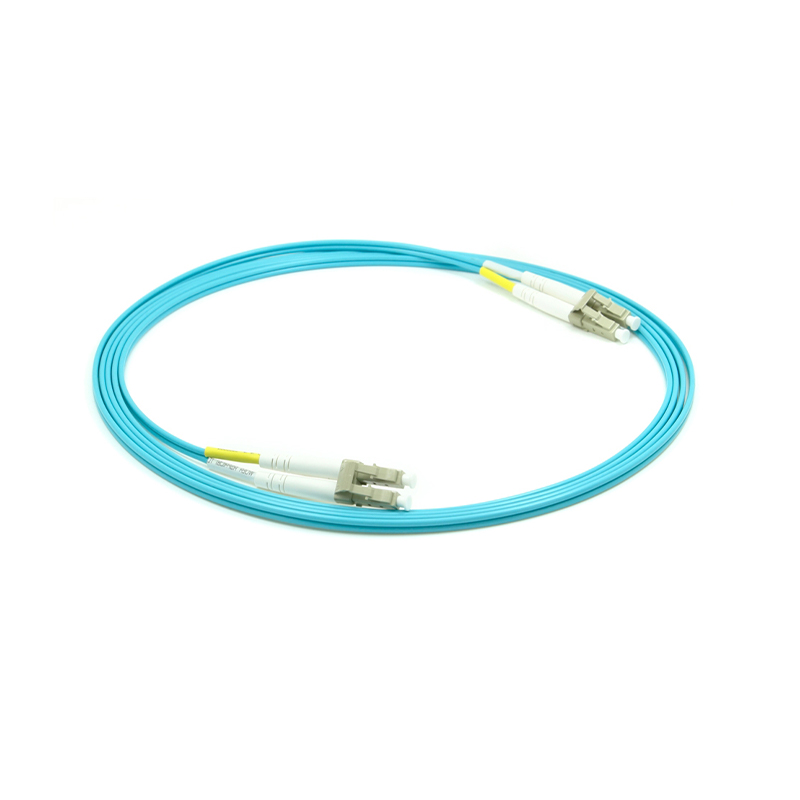 LC-LC DX Fiber Optic Patch Cord for Data CenterThis LC duplex patch cord offers stable performance with resistance to electromagnetic interference, making it well-suited for dense data center environments where cable proximity can cause signal issues.View Product →
 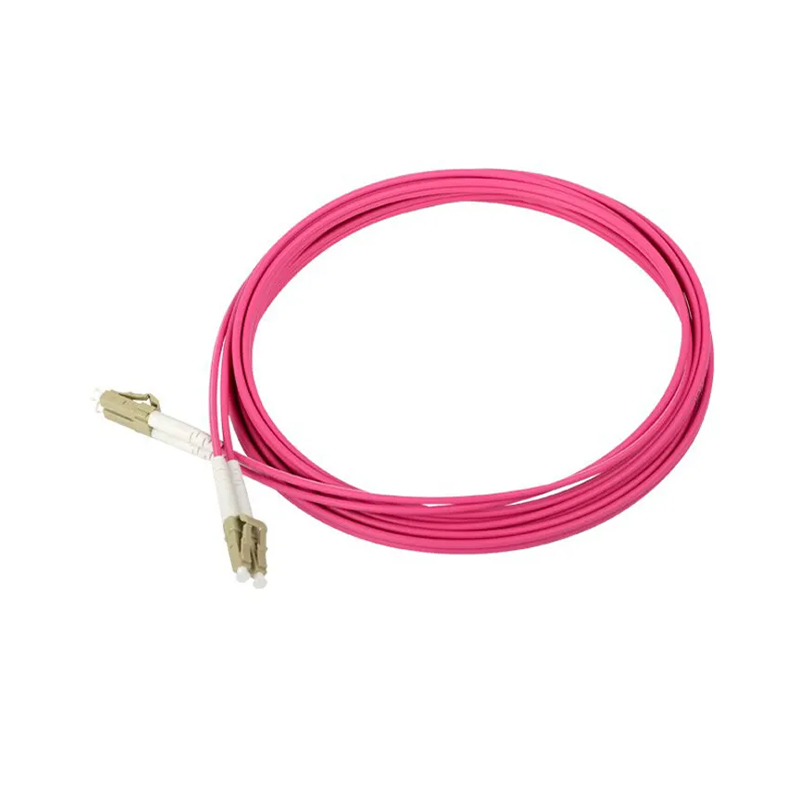 Flexible LC-LC Fiber Optic Patch CordDesigned for easy routing in tight spaces, this flexible LC-LC patch cord prevents internal fiber damage during installation, ideal for configurations requiring frequent reconfiguration.View Product →
How to Choose the Right Multimode Fiber Grade
Choose an OM grade by matching three variables: the Ethernet data rate you need, the longest physical link, and the transceivers already in your network. For new data center builds, OM4 is the default; OM3 is a lower-cost alternative when no link exceeds 100 meters; OM1 and OM2 are only worth considering for legacy maintenance and short low-rate connections.
Use this sequence when specifying:
- Confirm the fastest data rate planned now and within the next five years.
- Measure the longest path between the switch and the furthest device.
- Check whether the installed transceivers are VCSEL-based; 10G and faster optics require OM3 or OM4.
- Choose a grade whose reach is at least 20 percent longer than the longest path.
- Verify the connector type; LC is standard for modern SFP and SFP+ ports.
One detail buyers often miss is the end-face polish. Multimode systems use UPC polished connectors, while APC angled-polished connectors belong to single-mode systems. Ordering APC patch cords for a multimode plant creates high insertion loss and return loss, even when the connector physically fits.
If you are upgrading a legacy 1G network where SC ports are already installed, an SC-to-LC duplex patch cord lets you connect older switches to newer SFP-based equipment without rewiring the path.
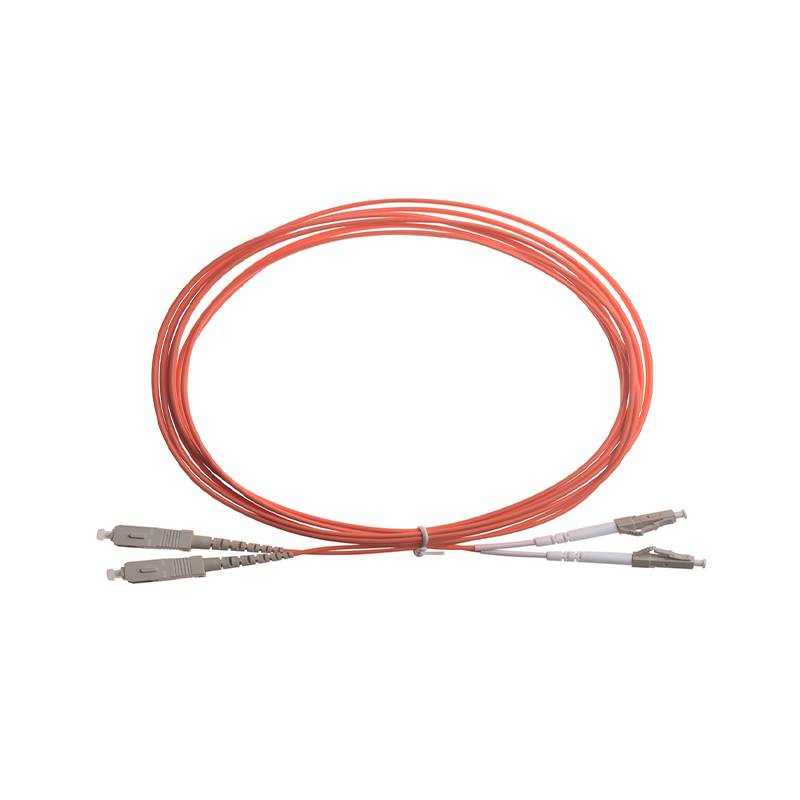 SC-LC DX Fiber Optic Patch Cord for Legacy NetworksThis SC-to-LC duplex patch cord lets you connect older SC-based switches to new SFP equipment, enabling smooth upgrades without rewiring existing paths in legacy 1G networks.View Product →
Five Multimode Fiber Procurement Mistakes to Avoid
Most multimode link failures in the field come from specification errors, not from defective fiber. These five mistakes account for most re-purchases and re-tests.
- Mixing OM grades in one channel. The channel operates at the lowest OM grade in the path. An OM4 patch cord on an OM3 backbone still performs at OM3 reach.
- Ordering single-mode patch cords by accident. The 9 µm core changes the launch condition and increases loss on a multimode link even though the connector fits.
- Quoting the wrong distance. The 550 m figure only applies to 10G on OM4. At 40G and 100G, the reach drops to 100 m on OM3 and 150 m on OM4.
- Ignoring jacket color discipline. Technicians rely on jacket color to identify grade. Non-standard colors cause incorrect patching and complicate troubleshooting later.
- Buying laser-optimized fiber for LED optics. OM3 and OM4 deliver their full bandwidth only with VCSEL transceivers. If your equipment still uses LED sources, the fiber upgrade will not improve link performance.
Frequently Asked Questions
What is the maximum distance of multimode fiber?
The maximum distance depends on the OM grade and the data rate. On OM4, 10G Ethernet reaches 550 m, while 40G and 100G reach 150 m. On legacy OM1, 10G barely reaches 33 m.
Can I mix OM3 and OM4 fiber?
You can, but the link performs at the lower grade. OM4 patch cords on an OM3 backbone give you OM3 reach, so the premium for OM4 only pays off when the entire channel is OM4.
Is multimode fiber more expensive than single-mode?
The fiber is comparable in price; the difference is in optics and connectors. Multimode transceivers cost less, and multimode connectors have looser tolerances that speed up installation. Single-mode wins on distance and scalability, not on purchase price.
When should I use single-mode instead of multimode?
Use single-mode when the longest link exceeds the OM reach, when you run outdoor or inter-building spans, or when you plan to move to 400G and want to avoid re-cabling. If you are still comparing cable constructions, our guide to fiber optic cables explains the main cable types in more detail.
How do I identify the OM grade of a cable?
Look at the jacket color and the print legend. Orange normally means OM1 or OM2, aqua means OM3 or OM4, and lime green means OM5. The markings on the outer jacket also list the grade and the core and cladding sizes.
Selecting multimode fiber does not need to be complicated. Measure the real link distance, confirm the optics, and choose an OM grade with at least twenty percent margin. If you are planning a purchase and want help matching patch cords, pigtails, and accessories to your network, contact our team and we will confirm the correct specification for your project.