

 English
 Español

 Inquiry
Industry News
What is a Fiber Optic Cable?
2026-01-09
An optical fiber cable is a type of communication cable composed of multiple glass or plastic fibers (optical fibers) encased in a protective layer. It transmits signals using the principle of total internal reflection. Unlike traditional copper cables, Fiber Optic Cable transmit light pulses rather than electrical signals, making them a core component of modern internet backbones, data centers, and high-speed broadband access (such as FTTH).
Content
How Fiber Optic Cables Work and Their Structure
The core technology of Fiber Optic Cable lies in their extremely fine internal glass filaments. Each optical fiber typically consists of three parts:
Core: The central high-purity glass layer where light propagates.
Cladding: The material surrounding the core, with a low refractive index, ensuring that light remains within the core.
Coating: A plastic layer that protects the glass from moisture or physical damage.
When a beam of light emitted from a laser or LED enters the optical fiber, it is repeatedly reflected at the interface between the core and the cladding. This phenomenon is called total internal reflection, enabling long-distance, low-loss information transmission.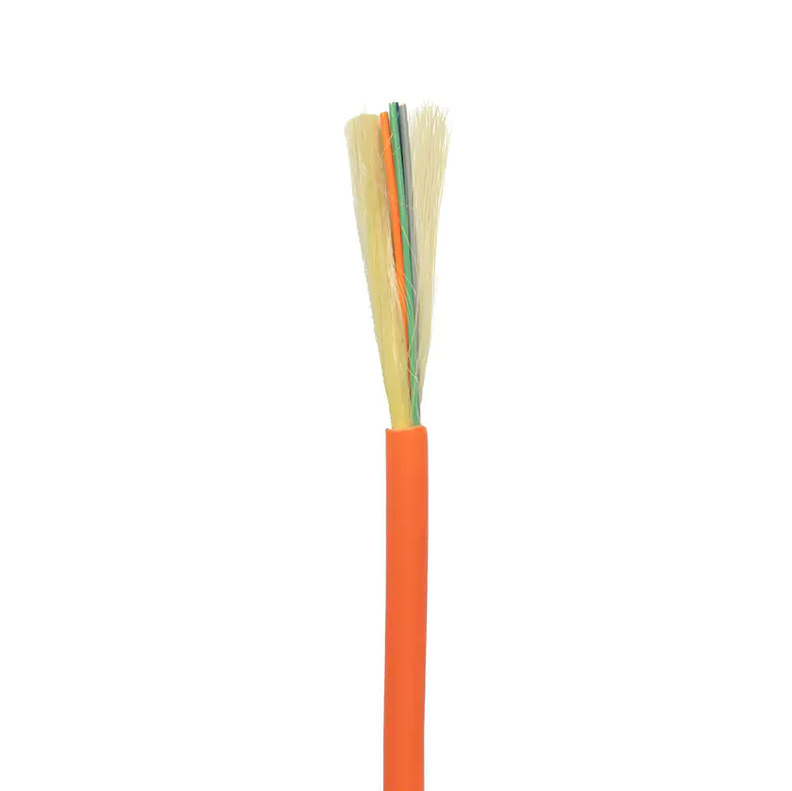
Why Choose Fiber Optic Cables? Key Advantages Analysis
In the field of high-speed communication, Fiber Optic Cable have completely replaced traditional coaxial cables and twisted-pair cables. The main reasons include:
Extremely high bandwidth capacity: Fiber optics can carry massive amounts of data, supporting transmission rates of 10Gbps, 40Gbps, and even over 100Gbps.
Long-distance transmission: Extremely low signal attenuation; signal transmission distances can reach tens of kilometers without repeaters.
Electromagnetic interference (EMI) resistance: Because it transmits light rather than electricity, fiber optic cables are completely unaffected by electromagnetic interference from lightning, high-voltage lines, or industrial equipment, resulting in excellent stability.
Higher security: Fiber optics are difficult to eavesdrop on because any physical damage will cause signal interruption, making it easily detectable.
Common Types of Fiber Optic Cables
Based on the transmission mode of light in the fiber, fiber optic cables are mainly divided into two categories:
1. Single-mode fiber (SMF)
Characteristics: Extremely thin core (approximately 8-10 micrometers), allowing only one beam of light to propagate.
Applications: Suitable for long-distance telecommunications networks, cable television backbones, and submarine cables.
2. Multi-mode Fiber (MMF)
Features: Thicker fiber core (approximately 50-62.5 micrometers), allowing multiple beams of light to propagate at different angles.
Applications: Suitable for short-distance transmission, such as enterprise local area networks (LANs) and data center internal connections.
With the widespread deployment of 5G base stations and the surge in demand for cloud computing, the demand for fiber optic cables continues to rise. From fiber-to-the-home broadband for homeowners to transoceanic submarine cables supporting global trade, fiber optic technology is constantly pushing physical limits.
In the future, with the maturation of multi-core and hollow-core fiber technologies, data transmission latency will be further reduced, providing a more solid foundation for high real-time applications such as autonomous driving, remote surgery, and the metaverse.


get in Touch

No.255 Lianfei Road, KandunIndustrial Park, Cixi City, ZhejiangProvince, China
Product Center
contact details
-
Email: [email protected]
-
Tel: +86 18367407397
Mobile
Copyright ? Ningbo Goshining Communication Technology Co., Ltd. Fiber Optic Solutions Manufacturer Fiber Optic Products Factory
